SWLAW Blog | Faculty Scholarship Spotlight
October 28, 2026
Faculty Appearances: September Highlights
Our September faculty digest highlights Southwestern scholars exploring constitutional rights, intellectual property, military law, and social justice through new scholarship, international conferences, expert commentary, and national media appearances.
Ronald Aronovsky
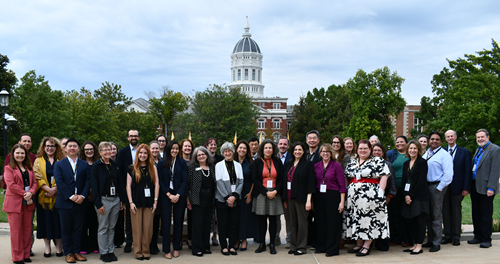
- On September 25-26, Ron attended the AALS Alternative Dispute Resolution Section’s 19th Annual Works-in-Progress Conference at the University of Missouri School of Law in Columbia, Missouri. On September 25, Ron presented his current work-in-progress, FAA Section 1: Opening the Door to State Regulation of Adhesion Arbitration. That same day, in his role as 2026 AALS ADR Section Chair, Ron presented the ADR Section's 2025 Best Scholarly Article Award and offered introductory remarks.
Luke Boso
- On September 18-19, Luke attended the ClassCrits XV Conference at Mitchell Hamline School of Law in Saint Paul, Minnesota. With Hila Keren, Luke organized a panel discussion entitled Resisting the Conservative Assault on LGBTQ+ People. As a panelist, Luke presented his forthcoming Article, Right-Wing Grievance and Queer Speech, 57 Seton Hall Law Review 1 (2026).
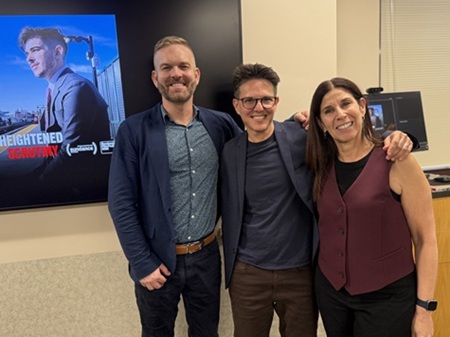
- On September 15, Luke moderated Southwestern’s annual Constitution Day event, this year entitled Law, Politics, and the Supreme Court. After working to secure an outside speaker for this year's event, Luke engaged in a conversational interview with UCLA School of Law Professor Joseph Fishkin on topics like partisan gerrymandering, voting rights, campaign finance, separation of powers, and executive power.
- On September 14, in conjunction with the Southwestern chapters of OUTLaw, ACLU, and ACS, Luke gave an in-person presentation to students entitled Louisiana v. Callais: The Supreme Court's Latest Attack on the Voting Rights Act.
Meera Deo
- On September 8, Meera was quoted in an Inside Higher Ed article, ABA Accreditation Council Votes on Long-Contested Diversity Standard, for her expertise on racial representation in law schools. Importantly, she noted that the Supreme Court’s Students for Fair Admissions decision does and should not affect most institutional efforts to “support students of color and others from marginalized backgrounds.”
Andrea Freeman
- On September 24, Andrea was invited to speak at the University of Victoria Faculty of Law in British Columbia, Canada. There, she discussed her latest book for the School of Indigenous Governance, in partnership with the Department of Gender Studies, School of Environmental Studies, and School of Public Administration. That same day, Andrea was also a guest speaker in a 200-person Environmental Studies course at the University of Victoria.
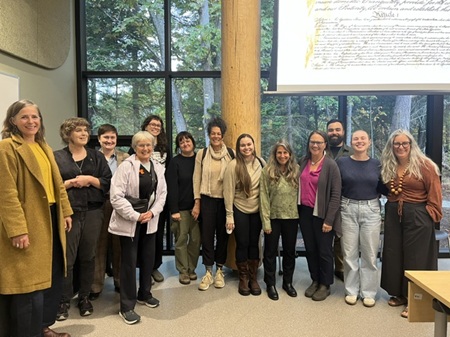
- On September 22, Andrea traveled to the Peter A. Allard School of Law, University of British Columbia, in Vancouver, Canada. There, she gave a talk, Food Oppression via US Food Law and Policy, as the Social Justice Visiting Speaker for the Centre for Law & the Environment at a lunchtime event for faculty, staff, and students across the university.
- On September 9, the It’s Personal podcast, hosted by Christopher Adamson, aired a 1-hour and 42-minute episode in which Andrea was the invited guest: Food Choice Is a Lie. In this episode, Andrea discusses “how law and public policy have shaped the American food system.”
Andrew Gilden
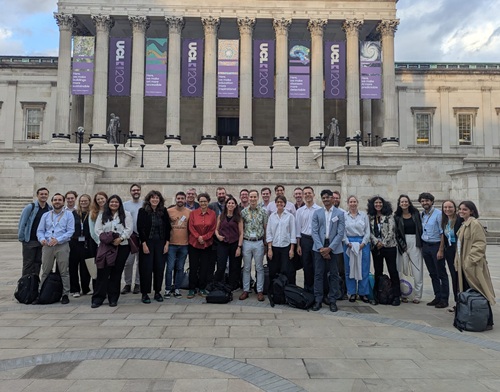
- On September 3-4, Andrew attended the Queering Private Law Conference (which he also co-organized) at the UCL Faculty of Laws in London, United Kingdom. There, he presented his work-in-progress (co-authored with Sarah Wasserman Rajec) entitled Trans Patents.
KJ Greene
- On September 30, the It’s Personal podcast, hosted by Christopher Adamson, aired a 1-hour and 35-minute episode in which KJ was the invited guest: Music Was Stolen. In the episode, KJ discusses “the complicated relationship between artists, ownership, and the music business.”
- On September 17, KJ participated in a California Lawyers Association Webinar, Cultural Appropriation vs. Cultural Exchange: Legal Lines in IP For Global Entertainment. Alongside University of Miami School of Law Professor J. Janewa Osei-Tutu, KJ presented his work on the intersection of cultural appropriation and intellectual property.
Hila Keren
- On September 18-19, Hila attended the ClassCrits XV Conference at Mitchell Hamline School of Law in Saint Paul, Minnesota. With Luke Boso, Hila organized a panel discussion entitled Resisting the Conservative Assault on LGBTQ+ People. As a panelist, Hila presented her forthcoming Article, Constitutional Opportunism, 104 Denver Law Review ___ (2026).
- On September 3-4, Hila attended the Queering Private Law Conference at the UCL Faculty of Laws in London, United Kingdom. There, Hila presented her work-in-progress, Queering Contract Law. In this chapter, Hila highlights the direct and epistemic ways in which queer people, and queerness as a way of experiencing and shaping the world, are currently marginalized under conventional contract law.
Faisal Kutty
- On September 25, Faisal published an Op-Ed in Newsweek: What if Israel Isn't Committing Genocide in Gaza? Taking seriously the legal requirement of specific intent under the Genocide Convention and arguments disputing that the standard has been met, Faisal asks what follows if the International Court of Justice does not ultimately find genocidal intent. He argues that legal precision remains essential, but the debate over whether conduct satisfies the technical definition of genocide should not obscure separate questions concerning civilian protection, alleged war crimes and crimes against humanity, or states' obligations to prevent grave violations of international law.
- On September 17, Faisal published an Op-Ed in the Toronto Star: Shunning Macklemore: Private Power Can Silence Speech, Even When the First Amendment Cannot. Taking as a case study Macklemore’s removal from Ed Sheeran's U.S. tour following Mackelmore's public expressions of support for Palestinians, Faisal examines the distinction between constitutional free-speech protections, which generally constrain government, and the considerable power private institutions and commercial actors can exercise over public expression.
- On September 14, Faisal was interviewed for and quoted in an article published in The Law Times: Jewish Lawyers’ Group Decries LSO Inaction on Antisemitism at TMU. He also published an expert analysis in Law360 Canada: TMU Controversy Tests the Limits of Law Society Regulation. Faisal offered his expertise and commentary concerning the Law Society of Ontario’s response to calls for the revocation of the Lincoln Alexander School of Law’s accreditation over allegations of antisemitism at Toronto Metropolitan University, examining the proper boundaries of professional regulation, university governance, and academic freedom.
- On September 12, following an interview concerning the 25th anniversary of 9/11, Japan’s national daily, The Mainichi, invited Faisal to write an opinion essay: From Japanese Internment to 9/11—When Emergencies Erode Our Rights. Faisal connects the wartime incarceration of Japanese Americans and Japanese Canadians with the post-9/11 experience of Muslim communities—not as equivalent histories, but as examples of the recurring danger that fear can weaken legal protections for unpopular minorities.
- During the week of September 23, The Mainichi published a Japanese-language version of Faisal’s essay following its earlier English-language publication.
- On September 11, Faisal published an Op-Ed in Newsweek: 9/11 Was 25 Years Ago, but the Emergency Never Ended. Faisal traces how extraordinary measures adopted after 9/11 became embedded in ordinary governance. He examines the expansion of surveillance and investigative powers, the creation of the Department of Homeland Security and ICE, Guantánamo, watch lists, drone warfare, and other elements of the post-9/11 security architecture.
- On September 11, Faisal published an Op-Ed in the Toronto Star: National Security vs. Personal Freedoms—the Debate Continues 25 Years Later. Marking the 25th anniversary of 9/11, Faisal examines Canada's post-9/11 national-security architecture. He argues that the enduring question is not whether governments may respond to genuine threats, but whether extraordinary powers introduced during emergencies should become permanent without evidence that the resulting loss of liberty produces greater security.
- On August 21, Faisal published a special report in the Washington Report on Middle East Affairs: Behind Closed Doors: What Secret University Networks Reveal About the Crackdown on Palestine Solidarity. Drawing on access-to-information reporting about networks through which Canadian universities shared information concerning Palestine solidarity encampments and institutional responses, Faisal examines the implications of treating student political expression as an emergency-management and security issue.
Tiffany Li
- On September 26, Tiffany was quoted in an article for Al Jazeera: Could AI firms be held responsible for mass shootings? Tiffany offered her expertise regarding the British Columbia versus OpenAI lawsuit.
- On September 14, Tiffany published an essay for the Brennan Center’s State Court Report: State Privacy Rights Are More Important Than Ever. Tiffany’s essay draws from her recent Article, State Constitutional Rights to Privacy, 59 Georgia Law Review 1307 (2025).
Yvette Lindgren
- On September 25, Yvette attended the Drexel Law Review Symposium, Under Pressure: The Future of the American Hospital, at Drexel University Thomas Kline School of Law in Philadelphia, Pennsylvania. There, Yvette presented her work-in-progress, Abortion Surveillance Care.
Jyoti Nanda
- On September 10, Jyoti attended the Western Region of the Gault Center’s virtual Roundtable. The Gault Center is a national training hub for youth defense, and Jyoti was selected as one of two scholars invited to present her research at its Roundtable to juvenile public defenders. Jyoti presented on her research examining how disabilities can manifest in young people as “criminal behavior.” She also advised defenders on how to incorporate current data and research findings into their advocacy to ensure clients receive the proper disposition (or sentence) from courts.
Orly Ravid
- On September 27, Orly attended the Calgary International Film Festival in Calgary, Canada. There, Orly spoke on a panel, How Independent Films Actually Get Made, regarding independent film financing and distribution. Orly also took the opportunity to promote Southwestern’s Entertainment & the Arts Legal Clinic.
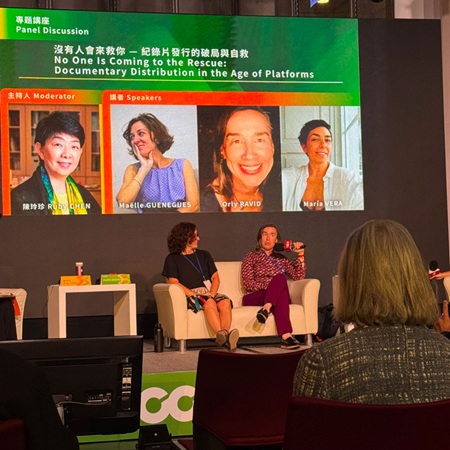
- On September 20, Orly attended the 17th CNEX Chinese Doc Forum (CCDF) in Taipei, Taiwan. There, Orly served as an industry expert and spoke on a panel entitled No One Is Coming to the Rescue: Documentary Distribution in the Age of Platforms.
Natalie Rodriguez
- On September 18, Natalie presented From Compliance to Continuous Improvement: Building the Quality Infrastructure for a New Online J.D. Program at the University of Dayton School of Law’s Online and Hybrid Learning Conference. Drawing from Southwestern’s Online J.D. Program, Natalie discussed how early workload data, credit-hour review, faculty collaboration, student-success advising, and course-level calibration can help new online programs move from compliance documentation to evidence-informed continuous improvement before bar passage and employment outcomes are available. She also served on the plenary Deans’ Panel, Deans on Starting and Growing Online and Hybrid Programs (moderated by Sara Berman), where she discussed curriculum design, asynchronous instruction, faculty support, student services, technology infrastructure, and quality assurance for online and hybrid J.D. Programs.
Rachel VanLandingham
- On September 30, the Lawfare Daily podcast aired a 56-minute episode in which Rachel was the invited guest: The Remaking of the Department of Defense. In this episode, Rachel discusses “how these changes are being implemented, what’s rhetoric and what’s reality, and what impact it’s all having on the Department and the troops themselves.”
- On September 15, Rachel provided extensive background information and was quoted in a Task & Purpose article: UN report says drug boat strikes are war crimes. What does that mean for US troops? Rachel offered her expertise regarding what type of criminal liability service members could face for crimes against humanity in the Caribbean and Pacific boat strike campaign.
- On September 18, Rachel was quoted in a Task & Purpose article: Why Moral Injury Could Be a Signature Wound of the AI Battlefield.
- On September 15, Rachel was a panelist at an ABA-sponsored webinar entitled, First Amendment Rights and the Uniform Code of Military Justice: Critiques of U.S. National Security Policy. Rachel explained the intersection of freedom of expression and military law, and she detailed the Trump Administration’s abuse of military-unique speech crimes.
- On September 11, Rachel was a panelist at a symposium sponsored by the UCLA School of Law entitled: 25 Years After 9/11: Reimagining Freedom, Justice, and Security. In her remarks, Rachel analyzed the process of legal whitewashing through DOJ and OLC memos—a process that was abused during the GWOT to enable war crimes of torture and cruel, degrading, and inhumane treatment. Rachel further explained how this process is again being exploited to justify the campaign of crimes against humanity, carried out by the U.S. military, which began last fall against alleged drug civilians in the non-war operation occurring in the Caribbean and Pacific.
Dov Waisman
- In September, Dov’s latest work-in-progress, Foreseeability and Reasonableness in Promissory Estoppel, garnered positive attention on two legal blogs.
- On September 10, Dov’s piece was “Highly Recommended” on Lawrence Solum’s influential Legal Theory Blog.
- On September 8, Dov’s piece was included in the ContractProfs Blog’s “New and Noteworthy on SSRN” section.
Bryce Woolley
- On September 30, Bryce guest-lectured in two courses for USC’s undergraduate Nautical Science program. His lectures focused on maritime tort jurisdiction and maritime collision tort law.